Silicon Zombies and the Hope of Resurrection
On digital replicas of the dead and the difference between imitation and resurrection.
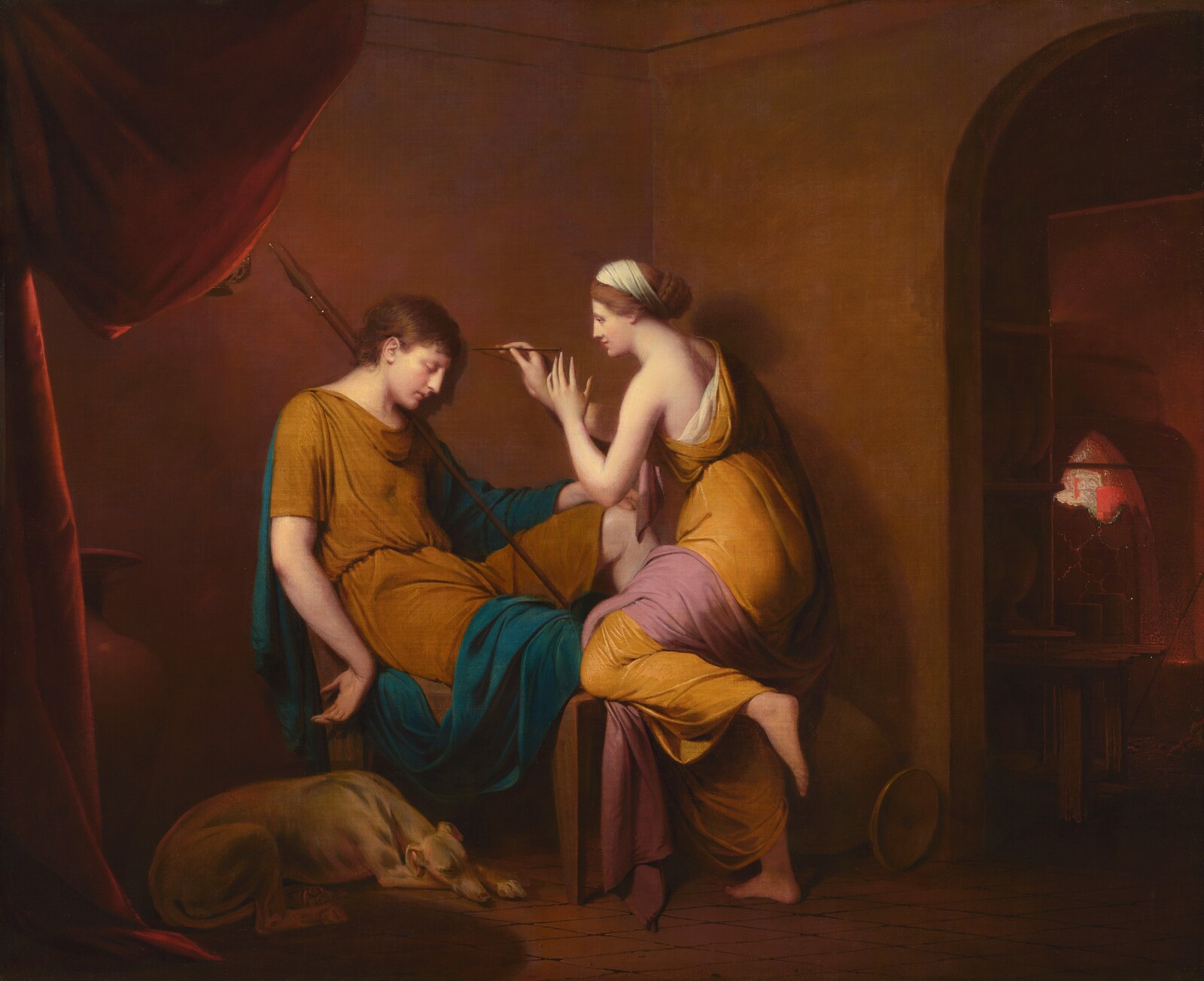
Image: Joseph Wright, The Corinthian Maid, 1782–84 · National Gallery of Art
Silicon Zombies Are Coming
There is a very high probability that some of your future descendants (if you have children) will gather every piece of digital data from your life in order to create a digital “replica” of yourself, against your (deceased) will, for their own pragmatic or psychological or “spiritual” benefit.
In his book The Singularity is Nearer, inventor, futurist and panprotopsychist Ray Kurzweil draws our attention to the development of what he calls “After Life technologies.” According to Kurzweil, these technologies will be used to preserve digital data from a person’s life (via their smartphone, emails, photos, videos, social media profiles, etc) in order to create a digital “replicant” of that person, one which “will have the appearance, behavior, memories, and skills of a person who has passed away.”1
Why might someone desire to create a digital replica of a beloved friend or family member before they die? Kurzweil names a few motives: “Many will see [digital replications] as valuable tools for continuing important work, sharing treasured memories, or helping family members heal.”2 Thus, digital replicants will function as “tools” in your descendants’ hands whereby they can access your story, memories, and personal information at a whim.
Toward the end of his reflections on “After Life” technologies, Kurzweil shares the following personal testimony: “In 2019 I gathered everything my father, Frederic Kurzweil, had written—all his love letters to my mother, course notes, a book on music he was writing, and his personal reflections.”3 He then provides an example of a “chat conversation” that he had with this deceased father, about which he says, “The replicant was able to give coherent, natural surprising answers to our questions—probably well enough that if I’d told you that this had been a conversation with my father while he was still living, you wouldn’t have noticed anything unusual.”4 And then, as if things weren’t strange enough, he adds the following: “I’m also planning to create a replicant of myself. It will have access to thousands of pages of my communications as well as all my published writings and countless hours of video. This foundation of rich multimedia would allow my replicant to represent my personality far more deeply and faithfully than my father’s.”
It is important to note that Kurzweil and others are currently engaging with digital replicants, but in the future, these digital replicants won’t stay digital. In the coming years, frontier AI companies (such as SpaceXAI) will integrate their AI tools with humanoid robots (such as Optimus), making it possible for you to interact with an AI-empowered, digitally-saved, robotic replicant of whoever you’d like to replicate.
Turns out, our imaginative fears about zombies may be justified, but instead of resuscitated bone and flesh, they will be made of silicon and your own personal data.
The Resurrection of Jesus Christ
Approximately 2000 years ago, the first-century world was “turned upside down” (Acts 17:6) by a shocking and revolutionary message, far more shocking than the modern potential of digital replication: a human being named Jesus of Nazareth was crucified, buried, and brought back to life three days after his death.
The claim of this “good news” was not that the body of Jesus had merely been resuscitated. No, it was far more shocking than that: it was that Jesus of Nazareth had truly died and had been truly raised from the dead.
Truly dead. Truly resurrected. Seen by hundreds. Proclaimed among the nations. Taken up in glory. And, according to his followers, coming back again.
Perhaps the most significant thing to note, especially in relation to the idea of digital replicants, is this: the Jesus who rose from the dead three days after his crucifixion was not a mere replica of the man from Nazareth. Nor was he a mere echo of his “appearance, behavior, memories, and skills” in a resuscitated body. No, the Jesus that was crucified was the same Jesus that rose, with physical wounds to prove it (see John 20).
What Do You Truly Desire?
Here’s the thing: I believe that the age of digital replicants is indeed coming. Unless the Lord tarries, a variety of technologies will enable us to speak with replicated, data-configured, virtual and/or robotic semblances of our deceased family members, loved ones, and friends. To put it in biblical terms: the witches from Endor are real, and they are waiting for us, just as they waited for Saul. This time around, however, their magic will come with a $20-per-month subscription.
It is precisely because of the reality of this dark magic that I feel a growing pastoral burden for believers to both understand and develop a growing confidence in the deeper (and truer and better) magic of the resurrection, and not only that, but of the resurrected Christ Himself.
I simply reject the notion that human beings genuinely believe a digital replication of the human person will be enough to satisfy our deepest longings for human connection (which, by the way, is only possible in terms of data preservation, not human preservation). We know, intuitively, that it is a falsehood, a mimicry, an “abomination.”
After all, do you desire to engage with your deceased loved ones only as they once were? Or, do you desire to engage with your deceased loved ones as they truly and really are—real, living persons, presently awaiting the reunion of their body and soul on the day of resurrection? Certainly the latter rings truer in our heart of hearts than the former.
The Invitation of the Gospel
Friends, here’s the good news, the news that will continue to be good, even in—and perhaps especially in—the age of digital replicants: The Jesus who stood in front of a crowd of dying people two thousand years ago and said, “I am the Resurrection and the Life,” is the very same Jesus who stands in our midst today and, by His Spirit, invites us to enter into the unending power of His resurrection—here, now, and forever.
So I invite you, dear reader, in a world that is full of counterfeit forms of life, to “take hold of the life that is truly life” (1 Tim 6:19). Namely, Jesus Himself.